The Great Fingering Debate - Tradition Vs Performance
By Chris Brooks
In the neoclassical shred guitar style, you'll see its leading exponent routinely playing licks comprised of whole tone and semitone spacing (eg, frets 10-12-13), with high-speed ostinatos, pedal tone licks and scale sequences. The Viking's digits of choice for this are the index, middle, and ring fingers.
Any time I play Yngwie Malmsteen-style stuff in videos related to my Viking Shred Guitar Suite course, you can bet your last dollar that it won't be long until comments appear along the lines of:
"Imagine if he knew how to use his pinkie finger"
"Oh look, he can only use three fingers"
"What a waste of four fingers"
Now, I don’t expect every random Facebook commenter to know my history as a player or that I’ve authored one of the top-selling books on legato technique - an approach that uses all four fingers abundantly. So, rather than writing these comments off as insults, it’s more useful to treat them as a starting point for a deeper conversation.
Let’s look at the merits - and the physiological failings - of their proposition.
One Finger Per Fret - The Source of Traditional Thinking
If you’ve ever taken a formal guitar lesson or cracked open a method book, you’ve likely encountered the One Finger Per Fret rule (OFPF). It’s the 'Home Row' of the guitar - a disciplined system that assigns each finger its own territory to ensure we aren’t constantly hunting for notes or shifting our wrists.

On paper, it’s perfect. It builds pinkie strength, organizes the fretboard into neat boxes, and provides a sense of 'positional safety.' For years, we’re told that breaking this rule is a 'bad habit' or a sign of a weak pinkie.
But as we transition from exercises to actual music - especially when playing at high speeds or in the higher registers, we have to ask: Is what’s best for 'discipline' always what’s best for 'performance'?
When it comes to the combination of the 3rd and 4th fingers, science has information that might challenge what your first guitar teacher taught you.
The "Shared Wire" Problem
Let's say you have some melodies built around fingers 1-3-4 from the diagram above. It makes sense to start there using OFPF spacing - easy to visualize and nothing too challenging physically, even with the length and strength discrepancies between the ring and pinkie fingers.
But when things become faster, more intricate, and rely heavily on interplay between the 3rd and 4th digits, that's the time when many players will start questioning their own ability. If that's you, maybe you've assumed that your synchronization is no good, or you just need to 'out-practice' the problem.
Science has some data on this - and it's not a you problem.
The Facts about Neural Coupling
The biggest challenge to the One Finger Per Fret rule isn't just muscle strength: it’s a quirk of our evolutionary wiring.
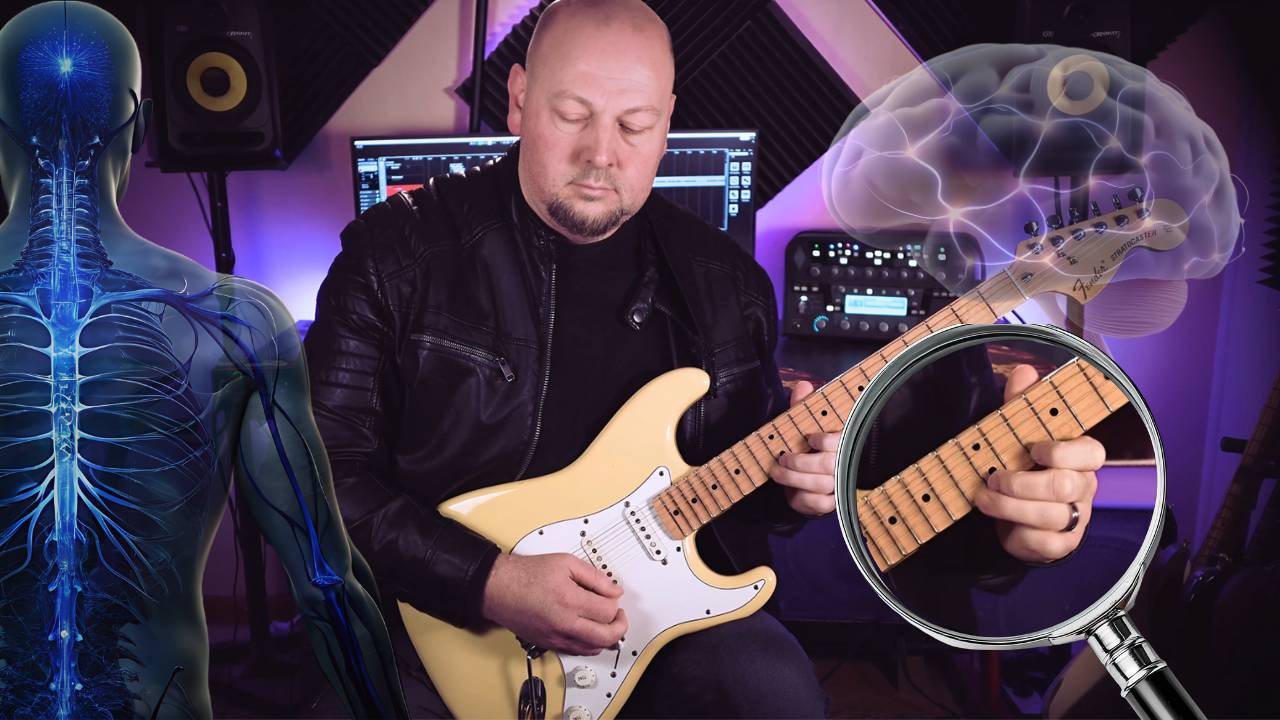
In neuroscience, there is a concept called Independence of Action. Our index finger (1) has a high degree of independence. However, the ring (3) and pinkie (4) fingers are "neurologically coupled." They actually share the same deep flexor tendon (Flexor Digitorum Profundus) and are often linked by a band of tissue called the juncturae tendinum.
When you force your hand into a 1-3-4 stretch:
-
The Conflict: Your brain is sending a signal for the ring finger to stay down while the pinky moves (or vice-versa).
-
The Tension: Because they are "wired" to move together, forcing them to act independently creates sympathetic tension. This tension travels up the forearm and can actually slow down your maximum speed or lead to fatigue.
The 1-2-3 Advantage: Tapping into "The Power Duo"
When you switch to a 1-2-3 fingering for fast licks, you are working with your biology rather than against it.
-
Neural Efficiency: Fingers 2 (Middle) and 3 (Ring) have a much more stable relationship. They are the "strong" fingers of the hand. By using 2 and 3 instead of 3 and 4, you are utilizing the fingers that have the most direct representation in the motor cortex (the part of the brain that controls movement).
-
Structural Support: When you use finger 3 for a note, finger 2 naturally sits right behind it, providing "backup" or "bracing." This is why 1-2-3 feels so much more "solid" for vibrato or fast legato. You are using the strongest part of your hand's neural map.
-
Reduced Cognitive Load: Because the 4th finger requires more "conscious" effort to control accurately, shifting to a 1-2-3 pattern reduces the mental energy required to execute a fast run. You’re essentially switching from a "weak link" connection to a "high-bandwidth" connection.

The Ulnar Nerve: Why the Pinkie Feels "Offline"
Beyond the tendons, there is a fundamental split in how your hand is powered. Your hand is primarily serviced by two different nerve paths: the Median nerve (which handles the thumb, index, and middle) and the Ulnar nerve (which handles the pinkie and half of the ring finger).
When you rely on a 1-3-4 fingering, you are splitting your technical demands across two separate "power grids." Because the ring and pinkie share that Ulnar "trunk," they often suffer from sympathetic tension - when one moves, the other wants to follow.
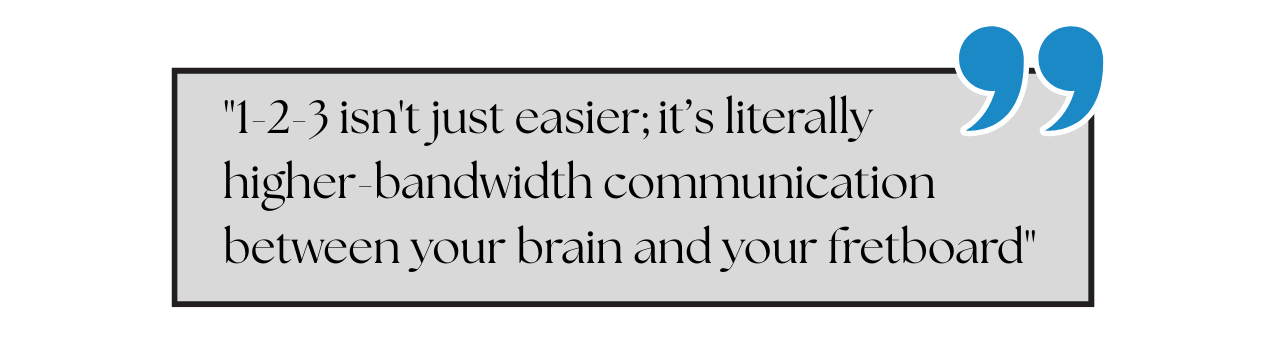
By shifting to a 1-2-3 approach, you are keeping the "heavy lifting" on the Median nerve side of the hand. This side of the hand is evolutionarily designed for high-precision tasks and power. In short: 1-2-3 isn't just easier; it’s literally higher-bandwidth communication between your brain and your fretboard.
The 1-2-4 Exception: Why the Pinkie Isn't the Enemy
It’s important to clarify: the "power grid" conflict isn't caused by the pinkie finger existing; it's caused by the ring and pinkie working in close proximity. This is why a 1-2-4 fingering (Index-Middle-Pinkie) often feels surprisingly fluid, even though you are using your smallest finger. In a 1-2-4 shape, you are bypassing the "shared wire" problem:
-
The Index and Middle (1 & 2): Are powered by the high-precision Median nerve.
-
The Pinkie (4): Is powered by the Ulnar nerve.
-
The "Buffer": By keeping the Ring finger (3) tucked away or passive, you allow the Ulnar nerve to focus entirely on the pinkie without the Ring finger creating sympathetic tension or "tugging" on those shared tendons.

In short, 1-2-4 works because it creates a "neurological buffer zone." The conflict only returns when you try to force 3 and 4 to move independently in rapid succession. This is why, for many players, the choice isn't just "Pinkie vs. No Pinkie" - it's about avoiding the 3-4 collision.
Conclusion: Finding Your Own "Home Row"
The One Finger Per Fret rule is a fantastic map for the territory of the guitar, but it isn’t the only way to travel. As we’ve seen, our anatomy - from the shared tendons in our palms to the neural pathways in our brains - often prefers a more compact, ergonomic approach.
Choosing to use fingers 1, 2, and 3 for those high-speed licks isn't "cheating" the pinkie. It's optimizing your performance based on how your body is built. By prioritizing stability and neural efficiency over rigid positional rules, you open the door to better vibrato, less fatigue, and a more fluid connection to your instrument.

The next time you find yourself struggling with a 1-3-4 stretch that feels "clunky," try shifting your hand and letting your first three fingers take the lead. You might find that the "wrong" fingering is actually the one your hand has been waiting for all along.
Chris

Chris Brooks is the founder of Guitar21 as well as the writer of 18 chart topping guitar technique books. His latest creation is Viking Shred Guitar Suite - the ultimate Neoclassical Shred Guitar course.