Wiring Your Shred: The Neuroscience of Guitar Practice
by Chris Brooks
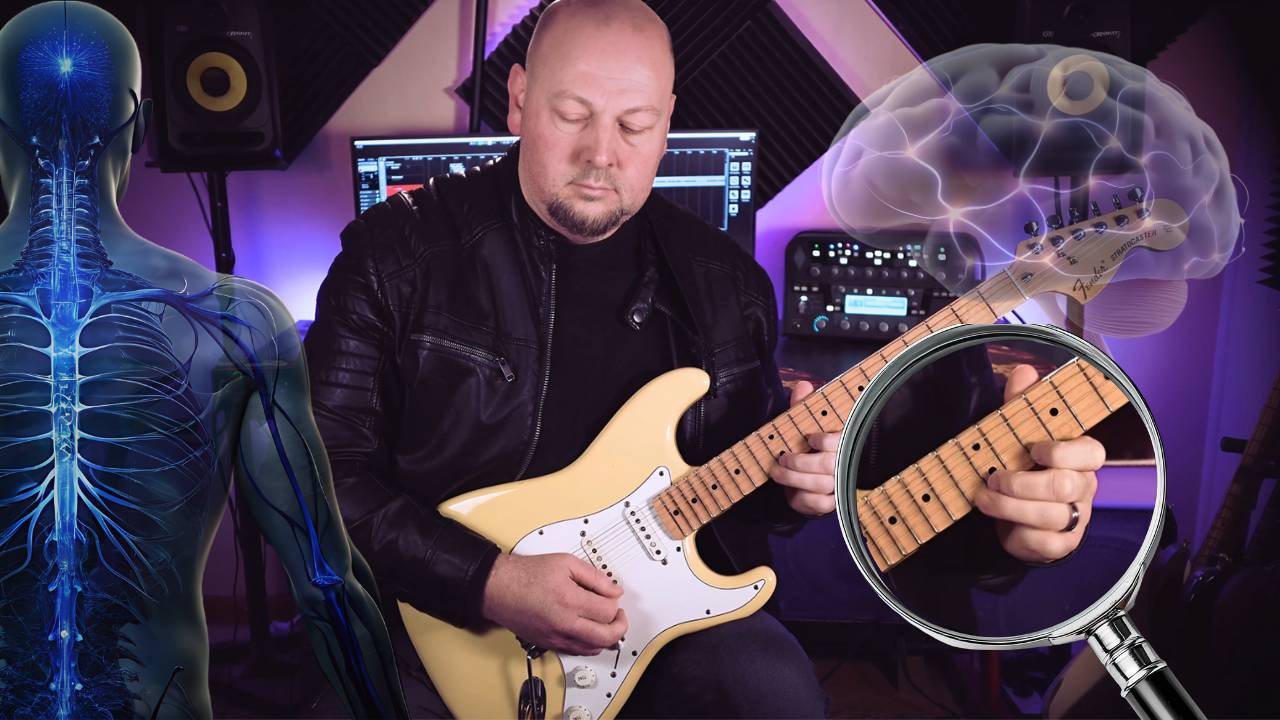
Ever wonder why an "impossible" chord change or scale suddenly feels effortless after a week of grinding? It feels like magic, but it’s actually biology. When you pick up your guitar, you’re not just training your fingers; you are physically rewiring your nervous system through a process called myelination.
The Myelin Highway
Every time you execute a movement, neurons fire along a specific pathway between your brain and your hands. At first, this path is like an overgrown hiking trail - clunky and slow. Enter myelin, a fatty sheath that wraps around nerve fibres.
Myelin acts like high-grade insulation on an electrical wire. When you repeat a motion, your body responds by wrapping that neural pathway in more myelin. This prevents signals from "leaking" and supercharges transmission speed. That frictionless feeling of "muscle memory" is actually just a highly myelinated neural autobahn.
The "Comfort Trap": Why Bad Habits Feel Good
Here is the catch: your brain is an impartial architect. It doesn't know the difference between a virtuoso sweep-picking technique and a clunky, tension-filled habit. It only recognizes repetition.
If you’ve spent months playing with a weird-looking wrist or flying fingers, those inefficient pathways are heavily myelinated. This creates a frustrating paradox: the "wrong" way feels more natural than the "right" way.
When a teacher corrects your technique, the new, better movement feels weak, awkward, and slow. That’s because you’re comparing a paved six-lane highway (the bad habit) to a freshly cleared dirt path (the new technique).
Your brain naturally wants to take the path of least resistance. You have to "even the score" by myelinating the new path until its efficiency surpasses the old one. Only then does the better option become your new "default."
Why "Slow Only" Practice Fails
While slow practice is crucial for memorizing, staying there indefinitely creates a bottleneck. Real-time playing requires lightning-fast feedback loops.
Your ears detect a micro-timing error, send a signal to the brain, which instantly fires a correction to the fingertip. If you only ever practice at 60 BPM, your nerves never learn to execute that "detect-and-correct" loop at 140 BPM. To put it more bluntly, all the 60 BPM reps in the world won't give you 140 without a technique capable of 140.
That doesn't then mean you should play a sloppy fast mess and let time alone clean it up! (Sorry Shawn Lane, I know you meant well but people misquote you all the time - RIP). That would be another case of myelination gone wrong.
Slow-only practice builds accurate roads, but it doesn't train the "drivers" (your nerves) to handle high-speed traffic. Early and regular exposure to speed is the testing process that will keep you honest and focused on the end goal.
By myelinating a technique that is clean but not ergonomically capable of speed, the process simply cements your place in the intermediate range.
Ideal Shred Zone
When you've committed a drill, lick or concept to memory, knowing how it's to be picked and fretted, figure out what your top speed is. Not just where it sounds perfect because, at that point, you're still probably holding back. What we want is the speed where - any more than this this, it will crash and burn. That's your current 100%
Constant repetition at 50.. 55.. 60% of you max might be fun and controlled, but it's not cleaning up your speed. I suggest putting more time into your 70-85% range. It's fast enough for you to be using "performance form" and controlled enough to make small adjustments on the go as your brain receives that crucial feedback.
Test regularly because your 100% will be higher the next time you really exert yourself.
The Architect’s Mindset
To master the guitar, you must be a conscious architect.
- Build the path: Work slowly to ensure the right neurons are firing.
- Insulate the path: Repeat the correct movement to layer on the myelin.
- Test the path: Regularly push the tempo to train your nervous system to react under pressure. You can do this sooner than you think.
Don’t assume speed and good habits come from obedient, slow training. Try them now and find out!
Chris

Chris Brooks is the founder of Guitar21 as well as the writer of 18 chart topping guitar technique books. His latest creation is Viking Shred Guitar Suite - the ultimate Neoclassical Shred Guitar course.